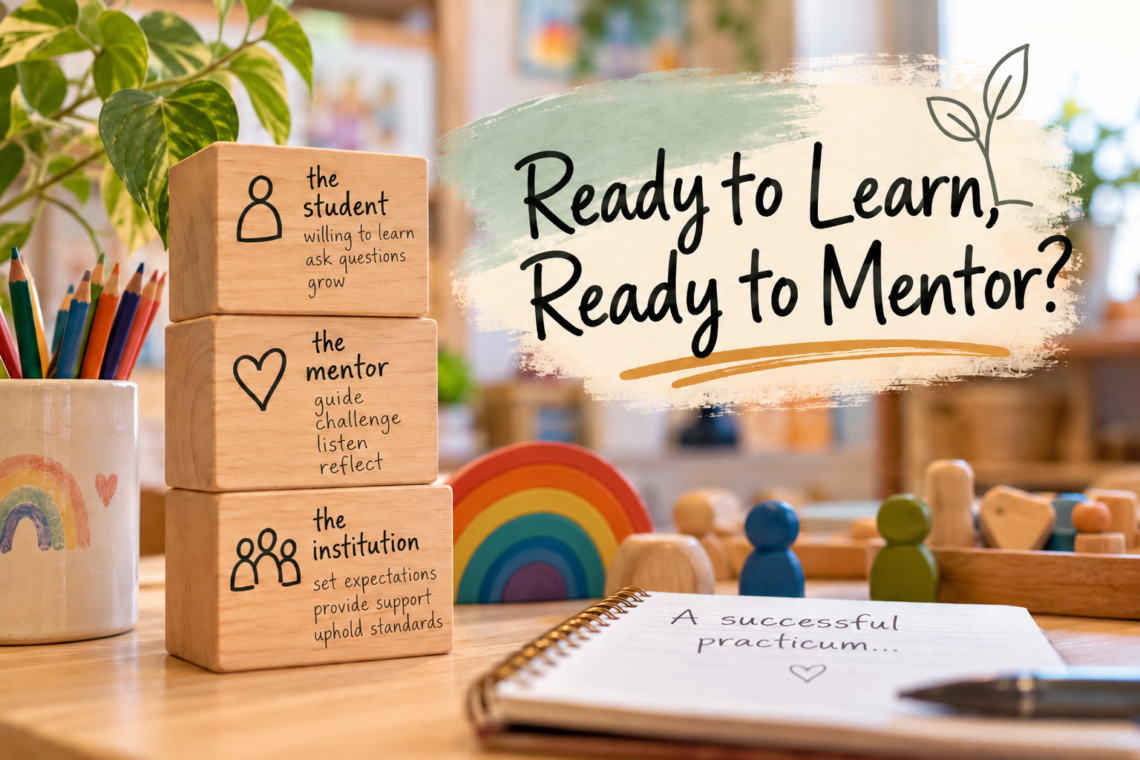
Ready to learn, ready to mentor?
I have only become the educator I am because, somewhere along the way, people decided I was worth their time.
People guided me. They listened to me. They were patient when I didn’t quite understand yet. They challenged my thinking and allowed me to challenge theirs. And, perhaps most importantly, they didn’t give up on me while I was still figuring out what kind of educator I wanted to be.
Of course, mentoring only works when there is someone willing to be mentored.
I had to be willing to listen, ask questions and receive feedback — including feedback I didn’t necessarily agree with. I had to be open to the possibility that the way I was doing something wasn’t the only way. Sometimes I changed my practice. Sometimes I didn’t. But I learned to think about why.

That is why I have always enjoyed having practicum students in my classroom.
I like being part of the beginning of someone’s career, but I also like how much they bring with them.
Students tell me what they are currently learning on their course. They ask questions that make me look at practices I have stopped questioning myself. They come from other practicum sites and have seen completely different environments, teaching styles and philosophies.
I know how valuable that is because my own practice has been shaped by different curricula, countries, cultures, workplaces and people.
There isn’t one single way to be a good educator.
I don’t want a practicum student to leave my classroom thinking exactly like me, I want them to leave thinking.
I want them to ask difficult questions.
Why do we do it this way?
What does the child experience in this moment?
Is this expectation reasonable?
Could I have responded differently?
What do I believe about children?
Some of the brightest students I have mentored have done exactly that. They have arrived curious, enthusiastic and sometimes unsure of themselves. They have listened, observed, tried, reflected, made mistakes and tried again.
You can see them slowly beginning to form their own educator identity.
And that is incredibly rewarding to witness.

Something else that has made me reflect on mentorship is hearing about the experiences students have had at their other practicum placements.
Some have described environments where their main responsibilities seemed to revolve around cleaning, tidying and being an extra pair of hands.
Now, don’t get me wrong. Those are all part of working in early childhood education. There is value in understanding the practical responsibilities of the classroom, and no educator is above cleaning a table or sweeping a floor.
But is that what practicum is supposed to be about?
If a student spends most of their placement completing tasks that help the classroom run, when are they being encouraged to think about why things are done the way they are?
When are they observing children with intention, discussing their observations, questioning practices, or receiving meaningful feedback?
And it makes me wonder about something else.
Who prepares the mentors?
We talk about students needing to demonstrate their knowledge, skills and readiness. But what about the educators who are responsible for guiding them?
Does being an experienced educator automatically make someone a good mentor?
I don’t think so.
Mentoring requires more than knowing how to do the job yourself. It requires patience, communication, the ability to explain your thinking and, perhaps most importantly, the willingness to question your own practice.
It also requires recognizing that the student isn’t there simply to learn how you do things. They are there to develop their own understanding of what it means to be an educator. That can be uncomfortable.
A student might ask why we do something a certain way, and perhaps we haven’t questioned it ourselves in years. They might bring ideas that challenge our routines or introduce perspectives we haven’t considered.
Are we willing to listen?
Are we willing to admit that we don’t always have the answers?
I believe mentoring should be a learning experience for both people and if we are asking students to be reflective, curious and open to feedback, shouldn’t we expect the same from those mentoring them?
Perhaps the question isn’t only whether students are prepared for practicum.
Perhaps we also need to ask whether practicum placements are prepared for students.
But mentoring has also taught me something much harder.
You cannot mentor willingness into someone.
Over the past year, three practicum students placed in our program have not successfully completed their practicums. One of them was directly under my mentorship.
I took that one personally.
My first thought wasn’t, They failed.
It was, I failed them.
I went back over everything I had done. Had I explained things clearly enough? Had I given enough examples? Was my feedback too complicated? Could I have approached it differently?
So I tried differently.
And differently again.
Eventually, I had to accept something I didn’t particularly like accepting: I could provide opportunities, feedback, patience and support, but I couldn’t do the learning for someone else.
That experience changed the way I think about mentorship.
Being a practicum student cannot simply mean being another body in the room.
A practicum should be an opportunity to watch, wonder, participate, ask questions, make mistakes, receive feedback and gradually understand both the profession and yourself within it.
I have found myself asking some uncomfortable questions about whether everyone entering ECE programs understands the responsibility they are stepping into.

The ECE field is experiencing workforce shortages, and at the same time the profession can intersect with pathways that make completing particular programs attractive for reasons beyond wanting to become an educator.
I don’t think we should be afraid to talk about that, but I also think we have to talk about it carefully.
I am an immigrant myself. English is not my first language. I know what it feels like to learn, work and build a professional identity in a language that isn’t your own. An accent doesn’t determine someone’s ability to be an educator, and neither does where they were born.
But communication matters.
If a student cannot yet understand feedback from their mentor without significant translation, communicate effectively with children and families, or demonstrate their own understanding of their coursework and observations, then I think we need to be able to ask whether they are ready for practicum.
Not whether they are intelligent.
Not whether they belong in the counrty.
Not whether their English is perfect.
Whether they are ready for the professional responsibility they are being asked to take on.
I think one of my current practicum students has actually helped me understand that distinction better.
She has openly mentioned the immigration aspect of choosing this course. Her English is still developing, and sometimes the work she brings to me is written in very broken English.
But it is hers.
She tries. She listens to feedback. She asks questions. She responds to what we discuss and tries again. She isn’t afraid to show me something imperfect and sit beside me while we work through it together.
And I appreciate that more than she probably realizes.
Because I can help someone develop their English. We can correct a sentence together. I can explain terminology differently. I can ask questions until I understand what she is trying to tell me.
What matters to me is that there is thinking behind those words.
Her experience has also challenged some of my own thinking. If immigration is one of the reasons someone initially chooses ECE, does that automatically mean they won’t become a committed educator?
Clearly, no.
Perhaps the more important question is what happens once they get here.
Are they curious? Do they engage with children? Do they accept feedback? Do they want to understand why we do what we do? Are they willing to be uncomfortable, make mistakes and learn from them?
Those are things I can mentor.
And then there are experiences that have shown me the other side.
Recently, I mentored another student who also struggled significantly with English. A translation app was needed to understand much of the feedback I was providing. At the same time, I became concerned that AI was being used to produce practicum work that didn’t reflect the understanding I was seeing demonstrated in the classroom.
When I asked to see the original observation notes or draft behind an assignment, there weren’t any.
After two weeks, I contacted the practicum instructor because I felt I could no longer ignore the gap between the work being submitted and the understanding being demonstrated in practice.
The student was removed from our program shortly afterwards. That wasn’t something I celebrated, but putting those two students side by side has made something much clearer to me:
Language can develop. Skills can develop. Confidence can develop.
What is much harder to mentor is the willingness to learn in the first place.
It made me also wonder how the student had reached that stage of the program without those concerns being addressed earlier. Perhaps that is where the conversation needs to become bigger than individual students.
What are our admission standards?
How are communication skills assessed before students begin working directly with children?
How do colleges distinguish between completing assignments and actually demonstrating understanding?
How are we responding to AI when a beautifully written reflection may no longer tell us whether the student can actually reflect?
And are practicum mentors being expected to discover gaps that should have been identified much earlier?
I want people to enter this profession.
We need them.
But needing educators cannot mean lowering our expectations of what it means to become one.
Children deserve educators who are curious about them. Who want to understand them. Who can communicate their needs. Who are willing to reflect, receive feedback and keep learning.

Mentoring the next generation of ECEs is something I genuinely love.
It is one of the ways I can give back some of the patience, guidance and belief that other people once gave me.
But the more I mentor, the more I realize that a successful practicum doesn’t depend on just one person.
It takes a student who is willing to learn, ask questions, reflect and grow.
It takes a mentor who is willing and able to guide, challenge, listen and reflect on their own practice, too.
And it takes an educational institution that sets meaningful expectations, provides appropriate support and takes responsibility for preparing both students and mentors for the experience.
When one of those pieces is missing, the learning experience can suffer.
Sometimes that means acknowledging that a student isn’t ready yet. Sometimes it means questioning whether a mentor is providing meaningful opportunities to learn. And sometimes it means looking beyond both of them and asking whether the systems we have in place are actually doing what we expect them to do.
I don’t believe every unsuccessful practicum is a failure of mentorship, just as I don’t believe completing a practicum automatically means someone is ready to become an educator.
But I do believe we need to be willing to ask difficult questions, even when the answers make us uncomfortable.
Because ultimately, practicum isn’t just about completing hours, passing assignments or having another pair of hands in the classroom.
It is about shaping the next generation of educators.
And that responsibility belongs to all of us.
So perhaps the question we should be asking isn’t only whether our students are ready for practicum, but whether we, as mentors, institutions and a profession, are truly ready to prepare them.
— The Teacher Behind the Crayons
💬 I’d love to hear from both practicum students and educators who have taken on the role of mentor. What has made a practicum experience meaningful for you? And what do you think we could be doing differently to better prepare and support the next generation of ECEs?
Discover more from Behind The Crayons
Subscribe to get the latest posts sent to your email.

But You Did It Yesterday…
You May Also Like
The Teacher Behind The Crayons
June 18, 2025
But You Did It Yesterday…
September 3, 2026