Honest Reflections

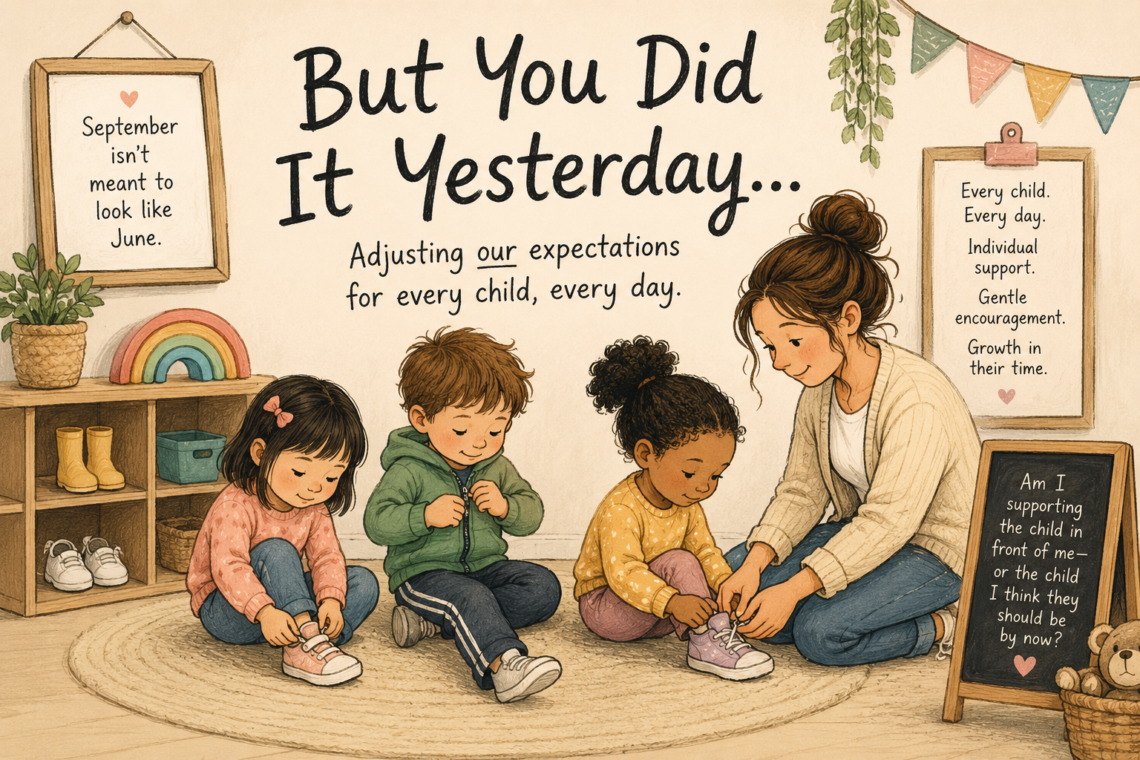
But You Did It Yesterday…

A new school year.

Some familiar children, some new children. Maybe an entirely new group, or perhaps many of the same little faces returning.

Either way, there is something exciting about beginning again.

We are about to create new bonds and new memories. We are going to discover new personalities, new group dynamics and, hopefully, new ways of thinking. We will watch children learn and grow — and if we’re paying attention, we’ll probably do quite a bit of learning and growing alongside them.

But with a new year, I think it is also a good time to look at something else:

Our expectations.

62913crayon_109295

I noticed this in myself at the beginning of this year. I was giving a direction or waiting for something to happen and thinking, “They know this.” Except… some of them didn’t.

The children I was unconsciously comparing them to knew it. They had spent the previous year learning our routines, practising them and figuring out what was expected of them.

As children’s skills develop, naturally, we begin to expect more from them. But I think we can also get stuck in the expectations created by our previous group.

By the end of the year, many of those children had been practising these skills and routines with us for a whole year — some even longer. Things that once needed reminders, guidance and support had simply become part of the everyday flow.

Then a new school year begins.

The children change. The group dynamics change. The skills and experiences they bring with them change.

But sometimes our expectations don’t reset with them.

We can forget that what felt “normal” in June took months of practice, repetition, support and relationship-building to get there.

September isn’t meant to look like June.

62913crayon_109295

And that’s not necessarily a bad thing. Children need opportunities to practise, try, struggle a little, problem-solve and discover what they are capable of.

But sometimes encouragement quietly turns into expectation.

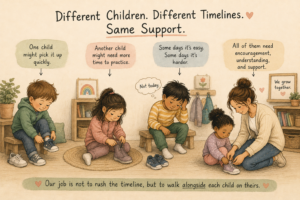
One child might quickly learn how to change their indoor and outdoor shoes independently. Another might master their zipper after a few tries. Someone else may need weeks of practice.

And another child might still need our help long after we thought they “should” be able to do it.

The tricky part is remembering that development isn’t a classroom checklist. Children don’t acquire skills at the same time, in the same order, or at the same pace. And even when a skill has been acquired, that doesn’t necessarily mean a child can access it independently every single time. I know I have caught myself doing this.

A child completes something independently one day and somewhere in my educator brain, a little box gets ticked:

Great. They can do that now.

Then the next day they ask for help.

“But you know how to do this.”

And technically, I’m right.

They do know how.

But knowing how to do something and having the capacity to do it in this particular moment aren’t always the same thing.

Maybe they’re tired.

Maybe the room is louder today.

Maybe they’re frustrated about something that happened five minutes ago.

Maybe their attention is somewhere else.

Maybe today they simply need a little more connection and support.

62913crayon_109295

Adults aren’t particularly consistent either.

There are things I have done hundreds of times that, on the wrong day, suddenly feel unnecessarily difficult. Sometimes my brain cooperates beautifully. Sometimes I walk into a room and forget why I’m there.

Yet we can expect children, whose skills and regulation are still developing, to demonstrate yesterday’s ability with today’s circumstances.

And when they don’t, it can be tempting to see it as unwillingness rather than changing capacity.

62913crayon_109295

There is another piece of this that I have been thinking about too:

Independence doesn’t have to mean doing everything alone.

Asking for help is a skill.

Recognising that something feels difficult is a skill.

Trying again is a skill.

Accepting support and then continuing is a skill.

Perhaps our job isn’t to remove support the moment a child demonstrates independence.

Perhaps it is to keep adjusting how much support we offer as they need it.

This is something we have also started talking about more intentionally as a team.

During our meetings, we remind one another that sometimes it isn’t the child’s behaviour or ability that needs adjusting — it’s our expectation.

We’ve even encouraged each other to gently “call each other out” when we notice that happening.

Not as criticism.

More as:

“I wonder if we need to change the expectation here.”

Because reflective practice isn’t only something we do alone after the children have gone home. Sometimes it happens in the middle of a busy classroom when another educator helps us see a situation slightly differently.

And I think that’s something worth carrying into a new school year.


62913crayon_109295

Of course we should believe children are capable.

Of course we should encourage independence, growth and new skills.

But believing a child is capable doesn’t mean expecting their capability to look the same every day.

Sometimes growth looks like doing it independently.

Sometimes it looks like trying.

Sometimes it looks like asking for help.

And sometimes it might simply mean that we adjust before asking the child to.

So perhaps, as we begin another year, a useful question to keep somewhere in the back of our minds is:

Am I supporting the child in front of me — or the child I think they should be by now?

Maybe the beginning of a new school year isn’t only a time for children to learn new routines and expectations.

Maybe it’s also a time for us to reset ours.

Because September isn’t meant to look like June — and neither is every child.

— The Teacher Behind the Crayons

💬 I’d love to hear from you! Have you ever caught yourself expecting something from a child simply because you knew they could do it — or because the children before them could? What helped you adjust your expectations?


Discover more from Behind The Crayons

Subscribe to get the latest posts sent to your email.

Leave a Reply

Your email address will not be published. Required fields are marked *