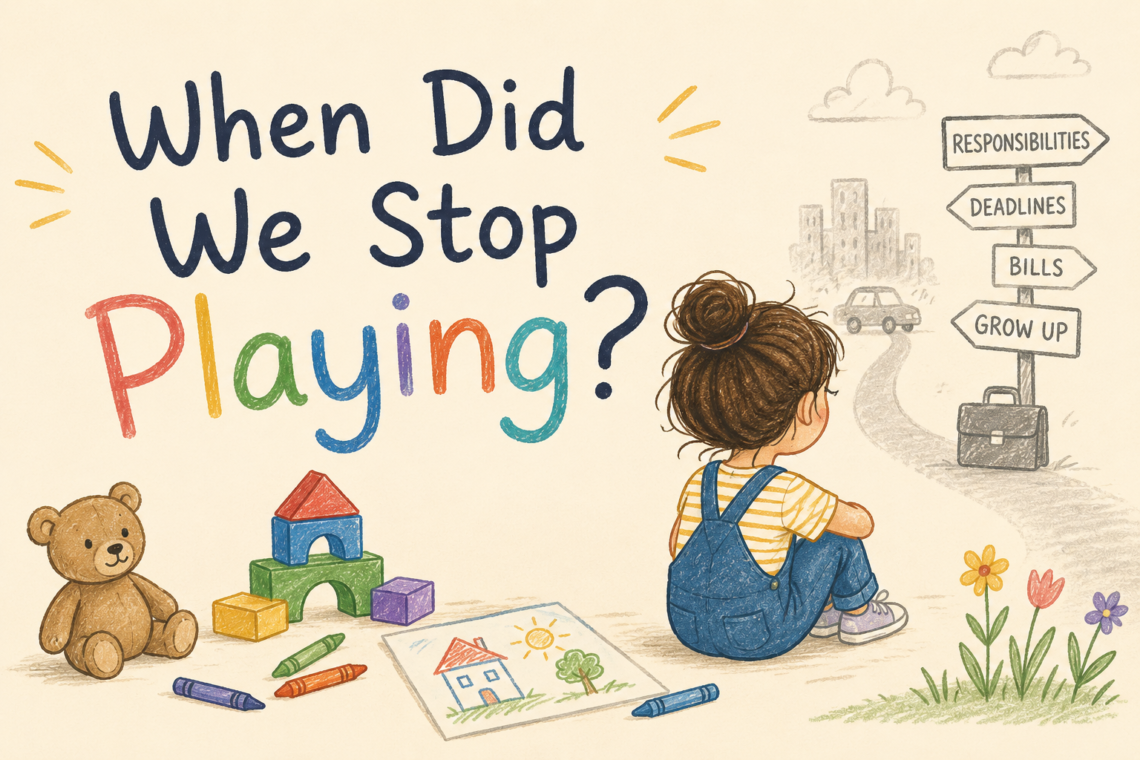
When Did We Stop Playing?
Our professional development day started like most of them usually do. Coffee. Conversations. Celebrating birthdays and milestones. People slowly waking up properly while trying to remember where they left their notebooks.
Then balloons appeared.
We were asked to get into pairs and simply… play.
At first, it felt slightly awkward in the way adult play sometimes does. The kind where people laugh while also looking around to check if everyone else is taking it seriously too.
We started bouncing balloons back and forth between us. Then we were encouraged to make it harder. Faster. More complicated.
And almost without noticing, the room was different.
People became louder, more energetic. Competitive in a playful way. There was laughing in the room, encouragement between partners, people moving around, reacting quickly, trying again when the balloon hit the floor.
The atmosphere felt lighter.
Later, our management explained there was a reason we had started the day that way. The activity was meant to prepare us for the next task — solving a problem involving a tea candle, pushpins, and matches.
The idea came from research discussed in the book Playful: How Play Shifts Our Thinking, Inspires Connection, and Sparks Creativity by Cas Holman, which explores the connection between play and problem solving. One of the concepts discussed was that people who engaged in playful activities beforehand were often more successful afterwards in creative thinking and problem-solving tasks.
And honestly, after spending few minutes throwing balloons around a room with a group of adults, I could believe it.
Because something about play seemed to loosen people.
Not just physically, but mentally too.
People seemed more willing to experiment, less afraid of getting things wrong, and more open to trying ideas without immediately worrying whether they would succeed or fail.
And perhaps that is part of what makes play so powerful in childhood too.
Not because children are “just having fun,” but because play creates space for curiosity, flexibility, imagination, experimentation, and creative thinking to exist together.
And somewhere in the middle of that day, I found myself wondering:
When did we stop allowing ourselves to play like this?

We all know that play holds an important role in children’s lives.
Their imagination carries them into worlds filled with curiosity, experimentation, wonder, movement, risk, storytelling, and fun. Through play, children explore ideas, relationships, emotions, problem solving, and themselves. It becomes part of how they make sense of the world around them.
And interestingly, when adults talk about children’s play, it is often with admiration. Sometimes even nostalgia.
People smile while remembering the freedom of riding bikes until the streetlights came on, building forts out of blankets, making up imaginary games, climbing trees, getting muddy, pretending sticks were swords or magic wands, or turning completely ordinary moments into something exciting.
Which makes me wonder:
If so many adults look back on play so fondly… why do we distance ourselves from it so much now?
Of course, experiences differ depending on culture, upbringing, and opportunity. But for many people in my generation — especially those of us now over thirty — childhood often seemed to contain more space for exploration, spontaneity, outdoor play, boredom, creativity, and freedom than many children experience today.
And somewhere along the way, playfulness itself seems to become something adults slowly grow out of.
When we speak about play, it is usually positioned as something for children.
But when adults engage in playfulness themselves, it can quickly become associated with immaturity, wasted time, distraction, or lack of productivity.
Almost as though adulthood quietly asks us to trade curiosity for efficiency.
To become more serious.
More composed.
More productive.
More scheduled.
Sometimes it feels as though society places adults into invisible boxes: go to work, complete the tasks, follow the routines, stay professional, keep moving.
And honestly, I think I have felt that pressure too.
I have always been playful. Both in my personal life and in my work. I like bringing energy into spaces, making ordinary moments feel lighter, laughing loudly, being a little ridiculous sometimes, and turning even small tasks into something more enjoyable.
But over time, I also became more aware of the looks, comments, and quiet judgments that can come with that.
The subtle feeling that perhaps I should tone it down a little.
Be quieter.
Be more serious.
Act more like an adult is apparently supposed to act.
And for a while, I think I started listening to that.
But the more I reflected on it, the more I started wondering:
Why?
Why do we accept exhaustion, stress, and emotional flatness as signs of maturity… but joy and playfulness as signs of immaturity?
And maybe part of the problem is that many adults are simply tired. Life becomes schedules, responsibilities, deadlines, routines, and constant productivity. Task after task after task.
Maybe playfulness is not disappearing because adults no longer need it.
Maybe it is disappearing because somewhere along the way, we were taught it no longer mattered.
When I think about how quickly adults apologise for silliness, or how often we hear phrases like:
“I’m too old for that.”
“I don’t have time.”
“I’d look ridiculous.”
…I cannot help but wonder what slowly happens to us over time.
Because eventually productivity seems to replace joy.
Play becomes something scheduled instead of something lived and I think that quietly shapes classrooms too.
Not because educators or parents do not care about children’s play. Quite the opposite, actually. Most people working with children deeply value it. We talk about play constantly in early childhood education.
But sometimes I wonder if the environments adults are trying to survive inside make playfulness harder to hold onto ourselves.
Classrooms are busy.
Ratios are demanding.
Documentation piles up.
Schedules matter.
Transitions have to happen.
Tasks need to be completed.
People are exhausted.
And exhaustion changes the way people move through the day.
It becomes harder to slow down enough to enter a child’s imaginary world when your brain is already thinking about the next routine, the next cleanup, the next task, the next expectation.
Sometimes play starts becoming viewed more as an activity to manage rather than a way of being alongside children.
Something to fit into the schedule.
Something to supervise.
Something to transition away from once “real tasks” begin again.
Perhaps that changes the atmosphere of classrooms more than we realise.
Children do not only learn from the activities we prepare. They also learn from the energy adults bring into the space — whether curiosity feels welcome there, whether imagination is encouraged, whether joy feels rushed, or whether play is treated as something valuable only when it is scheduled.
And honestly, I understand how that happens.
This is not about blaming educators or parents. I think many adults are trying to function inside systems that reward efficiency far more than curiosity, slowness, spontaneity, or joy.
Burnout culture does not leave much room for playfulness.
Society often praises adults for being busy, productive, serious, and constantly occupied. We are taught to admire people who push through exhaustion and keep going no matter how depleted they feel.
So perhaps it is not surprising that many adults begin interrupting play more quickly too.
Not always because the play itself is the problem, but because there are timelines to follow, routines to maintain, and pressure sitting quietly in the background of the day.
And yet children do not experience play as a break from learning.
For them, play is learning.
It is connection.
It is experimentation.
It is regulation.
It is creativity.
It is relationship building.
It is problem solving.
Which makes me wonder:
If adults slowly lose connection to playfulness themselves… how does that shape the way we respond to play in children?
The more I reflected on it, the more I started noticing how often play becomes something carefully contained within specific times and spaces.
In early childhood education, we value play deeply. We create invitations for it, plan environments around it, discuss its importance in meetings, write observations about it, and advocate for its role in children’s learning.
Sometimes I wonder if, somewhere along the way, play itself has also become heavily scheduled.
Contained to designated moments.
Expected to happen in particular ways.
Allowed… but only at appropriate times.
And maybe adults do something similar to themselves too.
“We schedule play times for children… but do we allow ourselves to be playful in the moments in between?”
Maybe the answer is not that adults need to suddenly become entertainers, constantly energetic, or endlessly creative, and reconnecting with playfulness is smaller than that.
Perhaps it begins with simply giving ourselves permission to loosen our grip a little. To stop viewing every moment through the lens of productivity and to remember that joy does not always have to be earned through completing something first.
When I think back to that professional development day, nobody in the room was being particularly “productive” while hitting balloons back and forth.
But people were connecting.
Laughing.
Thinking differently.
Relaxing.
Problem solving.
Becoming more open with one another.
Something shifted in the atmosphere simply because people were allowed to play without needing to justify it.
Children feel that shift too. They notice when adults are willing to be curious alongside them instead of only directing them.
When routines feel lighter.
When somebody sings during cleanup.
When transitions become playful instead of rushed.
When an educator is willing to be a little silly rather than always composed.
Playfulness does not always have to look like games.
Sometimes it exists in ordinary moments:
Humour during routines.
Curiosity during conversations.
Spontaneity in the middle of the day – the educator pretending the broom is a microphone for thirty seconds.
Turning small tasks into something enjoyable.
Being willing to laugh loudly.
Being willing to look a little ridiculous sometimes.
That is part of what children need from us too.
Not adults who have everything perfectly structured all the time, but adults who still remember how to wonder, explore, imagine, and enjoy moments alongside them.

The more I reflect on play, the more I realise it may not only be something we support for children.
Maybe it is also something many adults are quietly trying to find their way back to.
And perhaps that’s the answer to the question.
We didn’t stop playing because we outgrew it.
We stopped because somewhere along the way we forgot it mattered.
Somewhere between responsibilities, grocery lists, emails, and trying to remember why we walked into a room in the first place, play slowly slipped further down the list.
Maybe it’s time to remember.
To be curious.
To create.
To laugh.
To try something simply because it brings us joy.
And maybe to build a blanket fort once in a while, purely for research purposes.
After all, children spend most of their days trying to become grown-ups. Perhaps grown-ups spend part of theirs trying to remember what children already know.
Behind the crayons, play was never meant to stay in childhood. We just slowly forgot we were allowed to keep it.
— The Teacher Behind the Crayons
💬 I’d love to hear from you! When did you last find yourself completely lost in something you enjoyed—creating, building, exploring, laughing, or simply being curious? Do you think play belongs only in childhood, or is it something we all need a little more of? Share your thoughts in the comments below—let’s keep the conversation going.
References
Holman, C. (2025). Playful: How play shifts our thinking, inspires connection, and sparks creativity. Avery.
Discover more from Behind The Crayons
Subscribe to get the latest posts sent to your email.

They're Small...Not Lesser

You May Also Like
Transitions aren’t hard… until we make them.
May 12, 2026
Emotional Intelligence: Self-Regulation
June 23, 2025
One Comment
ExoWatts
Great content! Keep up the good work!