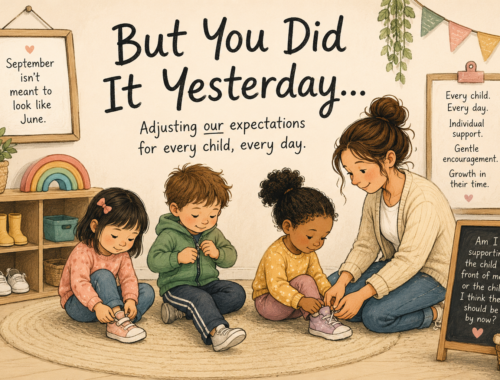
Is toilet training really an age milestone?
As a preschool teacher, this is one of those conversations that seems to arrive with the changing seasons.
We have started welcoming children from the toddler room for their transition visits before September, and one topic comes up again and again.
Potty training.
Last week, while chatting with one of our new families, a parent asked whether their almost three-year-old was “behind.” Their child had started toilet learning only two weeks earlier and was still having accidents.
They had also been told that leaving a child in pull-ups for too long would slow down their readiness to use the toilet independently.
I’ll admit… that was a new one for me considering that they started 2 weeks ago.
It also got me thinking about just how much pressure surrounds something that is, at its heart, simply another developmental milestone.
It sometimes feels like potty training has become one of those childhood milestones with an invisible countdown timer. Somewhere, someone decided that by a certain birthday children should magically wake up, blow out their candles, and suddenly have complete control over their bladder.
If only development worked like that.

Somewhere along the way, many of us started believing that by two-and-a-half or three years old, children should be toilet trained.
Parents hear it from friends.
Grandparents mention it.
Social media celebrates children who were “trained in three days.”
Sometimes childcare settings unintentionally add to the pressure as children prepare to move into preschool classrooms.
It’s no wonder so many parents quietly wonder…
“Is my child behind?”
The research says we may be asking the wrong question.
According to both the American Academy of Pediatrics and the Canadian Paediatric Society, toilet learning is most successful when it follows a child’s developmental readiness rather than their age. While some children begin showing signs of readiness around 18 months, many are not ready until well after their third birthday, and completing the process often takes months rather than days. There is simply no universal deadline.
In other words…
A child approaching three who is still having accidents isn’t necessarily behind.
They’re still learning.
That distinction matters.
In fact, a large longitudinal study published in Pediatrics found enormous variation in when children develop toilet-learning skills. Some children achieved daytime continence much earlier, while others did so considerably later, with nearly a year’s difference still falling within typical development. Even among children of the same age, readiness varied widely.

Perhaps the biggest misconception is thinking that toilet learning is simply about recognising the urge to go.
In reality, children are learning to recognise internal body signals, pause whatever exciting adventure they’re currently on—which, let’s be honest, can feel nearly impossible when dinosaurs are escaping, mud pies need one more stir, or someone has just discovered the world’s most interesting stick. And then walk to the bathroom, manage their clothing, relax enough to use the toilet, clean themselves, wash their hands, and return to what they were doing.
When we break it down like that, it’s actually a remarkably complex sequence of physical, cognitive and emotional skills.
Research supports this too. The American Academy of Pediatrics highlights that successful toilet learning depends on physical maturation, motor coordination, language development, cognitive understanding, emotional readiness, motivation and a growing sense of independence. That’s a lot happening behind one very small bathroom door.
This is also why starting earlier doesn’t necessarily mean finishing earlier.
Many parents assume that the sooner toilet learning begins, the sooner it will be mastered. Yet research reviewed by family physicians suggests there is little advantage to beginning before a child is developmentally ready. Starting too early may simply extend the learning process rather than shorten it.
Children don’t learn because we’ve circled a date on the calendar.
As convenient as it would be, children haven’t read the developmental milestone charts. They seem perfectly content following their own timetable.
They learn when their bodies and brains are ready to work together.
Experience:
One child in particular has stayed with me over the years. We’ll call him Tom.
When I first met Tom, he was around three and a half years old.
He was incredibly bright. His ability to remember facts and solve problems amazed me, and if you explained something from a scientific point of view, he was completely engaged. Socially, though, he found some things more challenging.
Like many children, people assumed that because he was still wearing pull-ups, his toilet learning was simply “behind.”
But the more I watched, the more I realised this wasn’t about not knowing how to use the toilet.
It was about fear.
Every day, when it came time to use the bathroom, especially for a bowel movement, Tom would refuse. He would hold it until it was time to go home. You could see the discomfort written all over his face. His little body would tense, he was visibly in pain, and yet he still couldn’t bring himself to let go.
Like many well-meaning adults, we tried encouraging him.
But encouragement can sometimes become pressure without us even realising it.
The more adults reminded him, the more anxious he became.
So I stopped focusing on the toilet.
Instead, I focused on Tom.
I sat beside him.
We talked.
When he looked uncomfortable, I didn’t ask, “Do you need the toilet?”
I asked, “Can you tell me what’s happening in your body?”
Slowly, he began to tell me he was scared.
Not naughty.
Not stubborn.
Scared.
He wanted me to stay with him in the bathroom because he didn’t feel safe trying on his own.
So I did.
Of course, I also had a classroom full of other children who needed me. There were moments I had to step out to help someone else, and I explained that to him honestly.
“I need to help my friends, but I’ll always come back.”
At first that worried him.
Over time, he realised I meant it.
Every single time.
That trust became just as important as the toilet itself.
I also noticed something else.
Trying to use the toilet while other children were coming and going made him even more anxious. So, together with my team, we adjusted what we could. We reduced the pressure, gave him more privacy, stopped reminding him every few minutes, and spoke about what was happening inside his body in a way that matched how he understood the world.
We met him where he was, instead of where we thought he should be.
Progress wasn’t quick.
There wasn’t a magical weekend where everything suddenly clicked.
It took time.
A lot of time.
Tom became fully confident with toileting around four and a half years old.
Some people might read that age and think, “That’s late.”
I don’t.
Because what I remember isn’t how old he was.
I remember the day he realised he could trust his own body.
And I remember the smile on his face when he no longer needed me sitting outside the bathroom door.
Tom reminded me that toilet learning isn’t simply about bladders and bowels.
Sometimes it’s about anxiety.
Sometimes it’s about trust.
Sometimes it’s about feeling safe enough to let go.
Research tells us children become ready at different ages.
Tom taught me why.
Pressure can also have unintended consequences.
When children begin to associate toilet learning with stress instead of confidence, they may resist using the toilet, begin withholding bowel movements, or experience constipation. Research consistently shows that a calm, child-led approach results in fewer difficulties than one driven by deadlines or expectations.
That doesn’t mean children should never be encouraged. Quite the opposite. Encouragement is incredibly important, but it works best when it supports readiness rather than trying to create it.
And then there are accidents. Even children who have been successfully using the toilet for weeks—or months—still have them.
Sometimes they’re deeply absorbed in play.
Sometimes they’re adjusting to a new classroom.
And sometimes they’re tired, excited, unwell or navigating a big life change.
Occasional accidents aren’t evidence that a child has failed.
If we’re honest, most adults have probably had at least one “I really should have gone before I left the house” moment too. We just tend not to talk about ours nearly as much.
They’re evidence that they’re still learning.
I also wonder if our language shapes how we think about this milestone.
We often hear,
“He’s not potty trained yet.”
But I’ve never heard anyone say,
“She’s not walking trained.”
or
“He’s not talking trained.”
Those skills emerge gradually. Toilet learning does too. What children need most isn’t another reminder that they’re getting older. They need adults who trust that development isn’t a race. After all, we don’t expect every child to walk on the same day. We don’t expect every child to speak in full sentences at exactly the same age. And we don’t expect every child to sleep through the night, regulate their emotions or make friends according to a universal timeline.
Toilet learning belongs on that list too.
As educators, I also recognise that childcare settings face practical realities. Preschool classrooms are busier, routines change, and independence becomes increasingly important. Those realities are understandable, but developmental readiness doesn’t always follow classroom timelines.

So perhaps instead of asking,
“How old is this child?”
we could begin asking,
“What is this child showing us they’re ready for?”
Because children aren’t behind simply because they’re developing at their own pace.
Sometimes they’re simply…
developing.
— The Teacher Behind the Crayons
💬 I’d love to hear from you…
Is there a child who changed the way you think about development?
Sometimes one child teaches us more than years of experience ever could.
Share your story below—I have a feeling many of us have one.
References
American Academy of Pediatrics. (2003/updated 2021). The Right Age to Potty Train. HealthyChildren.org.
American Academy of Pediatrics. How to Tell When Your Child is Ready. HealthyChildren.org.
American Academy of Pediatrics. Psychological Readiness and Motor Skills Needed for Toilet Training. HealthyChildren.org.
American Academy of Pediatrics. Cognitive and Verbal Skills Needed for Toilet Training. HealthyChildren.org.
Canadian Paediatric Society. Toilet Learning. Caring for Kids.
Schum, T. R., Kolb, T. M., McAuliffe, T. L., Simms, M. D., Underhill, R. L., & Lewis, M. (2002). Sequential acquisition of toilet-training skills: A descriptive study of gender and age differences in normal children. Pediatrics, 109(3), e48.
Discover more from Behind The Crayons
Subscribe to get the latest posts sent to your email.

Have I Already Written the Ending?

You May Also Like

Emotional Intelligence: Motivation
June 23, 2025
Strong Teams Build Strong Classrooms
March 15, 2026