Have I Already Written the Ending?
In my previous post, I wrote about how often we interrupt children while believing we are helping them. I have been wondering if we do something similar when we redirect children.
Not because redirection is wrong. Sometimes it is necessary. Sometimes it keeps children safe. Sometimes it prevents harm, but I have started noticing how often I feel tempted to step in before anything has actually happened.
And before I know it, I hear myself saying
“Don’t do that.” When a child climbs higher.
“Be careful.” When a child carries a bucket of water across the room.
“Stop.” When children start rough-and-tumble play.
“Watch out.” When a child balances on a log.
To be honest, sometimes I’ve imagined a five-second situation ending with three incident reports, two phone calls home, and somebody needing an ice pack… only to watch the children solve it before I’ve even finished mentally writing the paperwork.
If overthinking were an Olympic sport, I suspect many of us in early childhood could qualify.
Sometimes the situation genuinely requires intervention, but sometimes I wonder if I am responding to danger… or to my own discomfort.

Recently, my supervisor shared a position statement from the Canadian Paediatric Society, Healthy childhood development through outdoor risky play: Navigating the balance with injury prevention, after our team had a discussion with a family about rough-and-tumble play.
One phrase stayed with me long after I had finished reading it:
“Keep children as safe as necessary, not as safe as possible.”
At first, the difference seemed almost insignificant, but the more I thought about it, the more I realised it wasn’t just talking about risky play. It was talking about us.
The article explains an important difference between risk and hazard. A risk is something a child can see, think about, and learn to manage. A hazard is something they cannot reasonably recognise or control. Our role isn’t to remove every challenge from a child’s day. It’s to remove hazards while supporting children as they learn to navigate manageable risks.
That completely shifted the way I think about my own role.
Maybe my job isn’t to prevent every uncomfortable moment.
Maybe it’s to stay close enough to support while resisting the urge to solve every problem before children have had the opportunity to think.
I started wondering if this same idea applies far beyond climbing trees or balancing on logs. It shows up in the language we use every day when a child spills water, paint splatters, blocks fall or someone bumps into somebody else.
And our first instinct is often to ask,
“Why did you do that?”
But what are we really asking?
Often, we’re asking children to explain themselves before they’ve even had the chance to solve the problem.
What if, instead, we said,
“That’s a lot of water on the floor. What could we do next?”
Suddenly, the conversation shifts from blame to problem-solving.
Sometimes a child slips.
Sometimes they discover a branch wasn’t as stable as they expected.
Sometimes they realise they’ve climbed high enough and decide to come back down.
Each of those moments gives children information about their own bodies, abilities, judgement, and limits.
Perhaps those experiences aren’t interruptions to learning. Perhaps they are the learning.
Experience:
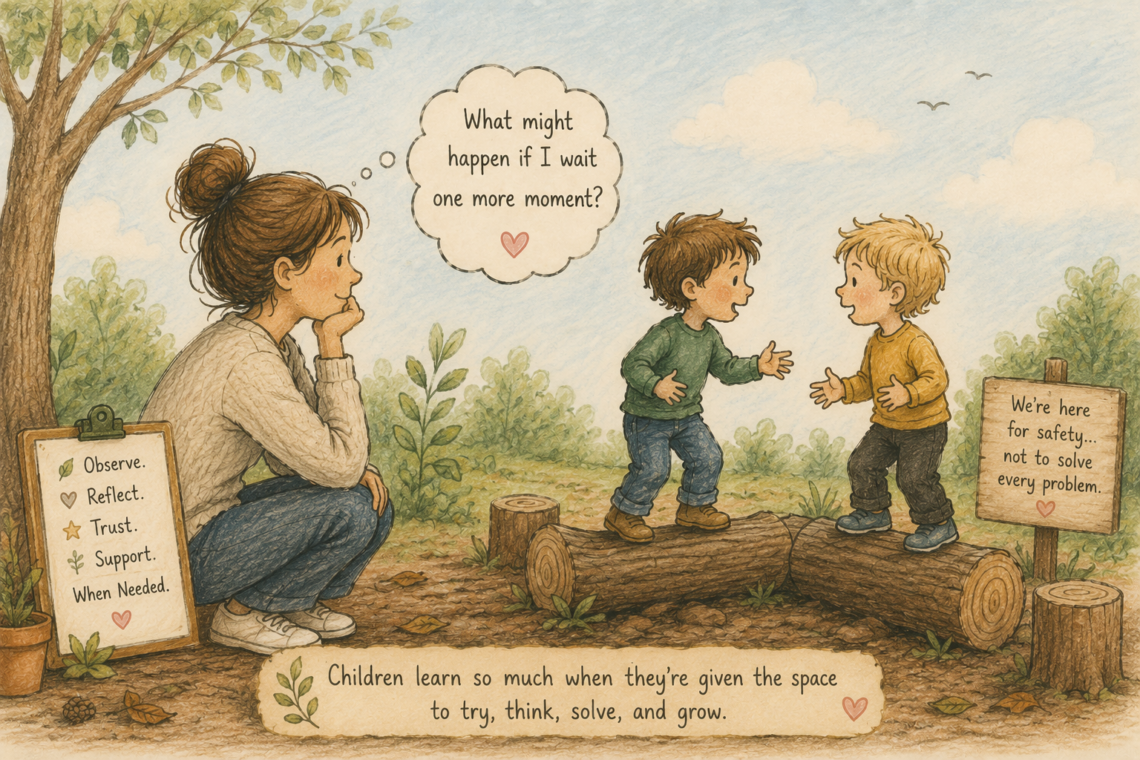
Two preschool boys were outside, balancing on some logs. They both wanted to be first to climb onto the same one. Voices started getting louder, there was a small push, and I immediately felt myself preparing to step in.
In my mind, I had already written the ending.
This is going to turn into a bigger conflict.
But instead of reacting straight away, I paused. I stayed close enough to intervene if someone became unsafe, but I chose to watch for just a little longer.
The boys kept talking.
“I wanted to be first.”
“But I was there first.”
Yes, they were frustrated. Their voices became louder for a moment. But then something happened that I hadn’t predicted.
One of them stopped and said,
“We can take turns. You can go first.”
And just like that, the problem was solved. Not because an adult stepped in with the answer.
Because the children found one together.
Later, I went over to them and told them how much I appreciated the way they had worked through the disagreement, listened to each other, and found a solution together.
Walking back inside later that day, I realised something. The children hadn’t learned the biggest lesson that afternoon.
I had.
I had assumed conflict meant they needed me. They showed me they needed space. Not because they solved it perfectly, but because they were already using skills I’d been trying to teach them.
If I had stepped in the moment I saw the push, I probably would have prevented the argument, but I also would have prevented the negotiation.
The compromise.
The perspective-taking.
The problem-solving.
In trying to stop the discomfort, I might have interrupted the learning.
Interestingly, I don’t think this only happens with children. Think about the last time an adult made a mistake. Imagine someone accidentally dropped a mug in the staff room. Would our first response really be:
“Why did you do that?”
Probably not.
Or imagine arriving a few minutes late to work because traffic was unexpectedly backed up. If the very first thing someone asked was, “Why were you late?”, how would that feel? Most of us would immediately begin explaining ourselves. We’d become defensive before we’d even had a chance to think.
Yet children experience that feeling every day. The question itself isn’t the problem. Sometimes “why” opens wonderful conversations. The timing is what matters. Immediately after a mistake, “why” often feels less like curiosity and more like a request to justify ourselves.
Whether we’re five years old or forty-five, most people respond to that by protecting themselves rather than reflecting.
The more I reflect on my own practice, the more I realise that many of my interventions have very little to do with children and a lot to do with me.
My experiences, my fears, my assumptions about what might happen and/or my desire to prevent discomfort before it appears.
Sometimes children need us to step in.
But sometimes they also need us to step back.
The most supportive thing we can do is resist the urge to solve the problem for them and trust that they are capable of being part of the solution.
Every time we immediately direct, correct, or rescue, we send a message. And the message might not be:
“I’m helping you.”
The message might be:
“I don’t think you can do this without me.”
The skills we hope children develop—problem-solving, emotional regulation, negotiation, resilience, confidence—don’t appear after we’ve solved enough problems for them.
They develop because children are given opportunities to practise them.
Children are often more capable than we realise. Sometimes the biggest thing standing between them and using those capabilities is our certainty that they can’t. I am starting to wonder how often children are ready long before we are willing to trust them.
Perhaps the next time we feel the urge to jump in, the question isn’t, “What could go wrong?”
Maybe it’s, “What could they learn if I waited just one more moment?”
— The Teacher Behind the Crayons
💬I’d love to hear from you.
Have you ever watched children solve a problem you were just about to step in and solve for them?
Or is there a moment that changed the way you think about guidance, trust, or giving children just one more moment to think?
I’d love to hear your story in the comments. I have a feeling many of us are learning just as much from children as they are from us.
References
Beaulieu, E., & Beno, S. (2024). Healthy childhood development through outdoor risky play: Navigating the balance with injury prevention. Paediatrics & Child Health, 29(4), 255–261. Canadian Paediatric Society. https://cps.ca/en/documents/position/outdoor-risky-play
Discover more from Behind The Crayons
Subscribe to get the latest posts sent to your email.


You May Also Like
A Lap, A Leak, and the Importance of Emergency Underwear
June 23, 2025
Emotional Intelligence: Self-Regulation
June 23, 2025