They’re Small…Not Lesser
“Come on, we’ve already talked about this.”
“Hurry up.”
“You’re fine.”
“Use your words.”
Which, to be fair, is interesting advice coming from adults who sometimes need an iced coffee, a silent drive home, and at least two hours before discussing their feelings.
Most of us who work with children, or have children in our lives, have probably said versions of these phrases before. I know I have.
Not because we do not care and not because we want to dismiss children. But because classrooms are busy. Days move fast. Emotions rise quickly. There are routines to follow, transitions to manage, and moments where patience feels thinner than we would like to admit.
And honestly, sometimes there are seventeen children talking at once while somebody is crying because their banana broke in half and another child is emotionally devastated that yesterday is not tomorrow yet.
But somewhere in the middle of all that noise and movement, I sometimes catch myself wondering :
Would I speak to an adult like this?
Would I interrupt them while they were trying to explain themselves?
Would I dismiss their feelings that quickly?
Would I expect immediate emotional regulation while speaking from my own frustration?
Somewhere along the way, childhood can quietly become treated as “less than.” Not intentionally and always harshly, but subtly.

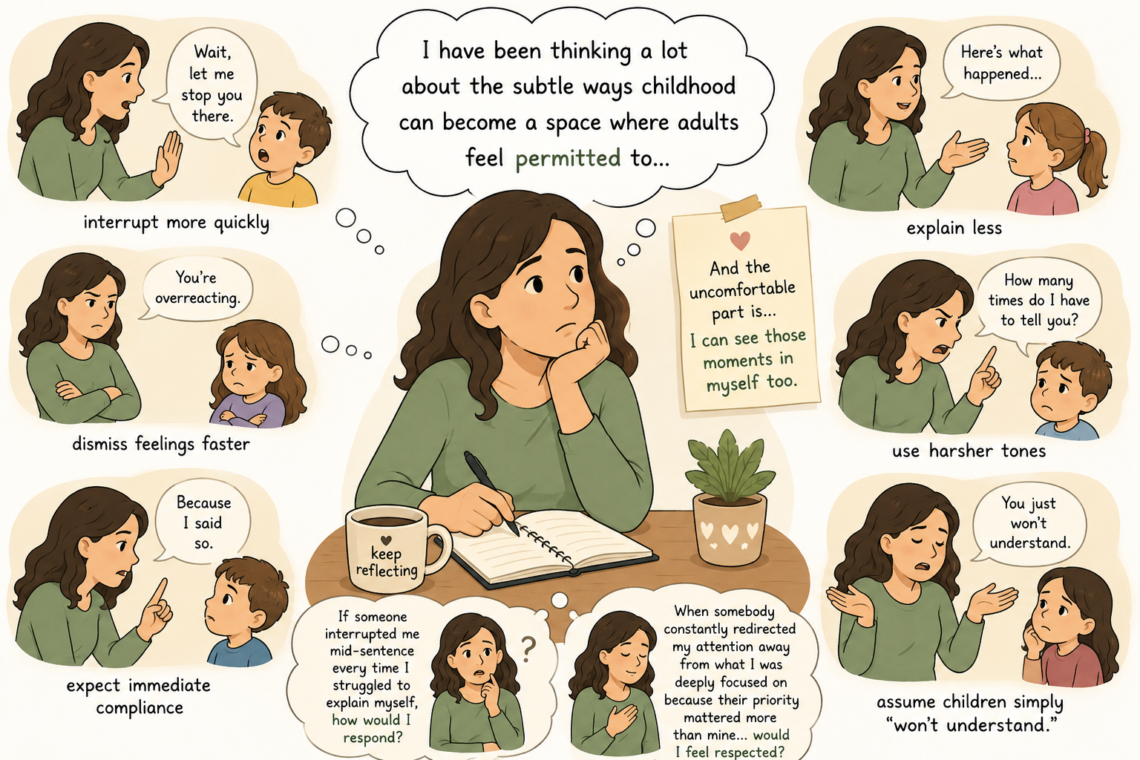
I have been thinking a lot about the subtle ways childhood can become a space where adults feel permitted to interrupt more quickly, dismiss feelings faster, expect immediate compliance, explain less, use harsher tones, and assume children simply “won’t understand.”
And the uncomfortable part is… I can see those moments in myself too.
I have started catching myself wondering why I interrupt children so often. Whether it is during conversations, while they are playing, or when they are trying to explain something in the long, winding way children often do. And yes, sometimes those explanations begin somewhere around breakfast and eventually circle back to the original point twenty minutes later.
But still.
If someone interrupted me mid-sentence every time I struggled to explain myself, how would I respond?
When somebody constantly redirected my attention away from what I was deeply focused on because their priority mattered more than mine… would I feel respected?
As I have been reflecting on this more, I can see several things that have contributed to my own behaviour over the years.
Part of it is definitely the habit. A learned assumption that children either will not understand what I am trying to explain or do not need the same level of explanation in the first place.
A lot of it has also been connected to my own stress. I have become much more aware of how quickly stress can push me toward a sharper tone, quicker dismissals, or wanting immediate cooperation simply because I feel overwhelmed myself.
And when I think back to earlier years in my practice, I can also recognize how power imbalance played a role.
I think sometimes, when we feel a lack of control elsewhere in our lives, we unconsciously seek it somewhere we know we can find it.
Children.
Because they are smaller. Because they rely on us. Because we are the ones with more answers, more authority, and more control over the environment around them.
Culture plays a role in this too.
Some approaches place a strong emphasis on obedience and authority. Others lean more toward collaboration and autonomy. And a lot of the time, people communicate with children in certain ways simply because that is how communication was modeled to them growing up. We often repeat what feels familiar without realizing there are other ways to relate.
Perhaps one of the biggest factors underneath all of this is urgency.
We live in a world where time always seems to be running out. There is always something to do, somewhere to be, something to clean, fix, organize, prepare, respond to, or catch up on.
Everything feels rushed.
Somewhere in the middle of all that rushing, children are often expected to keep up with systems built around adult timelines, adult priorities, and adult pressures.
So I wonder:
Why are we so willing to make time for everything else… at the expense of children?
I think sometimes we underestimate just how observant children really are.
Children notice everything.
They notice the shift in our delivery before we even finish the sentence. They notice the tension in our body language. They notice when patience disappears. They notice when our responses become sharper, quicker, colder, louder.
And because children are often described as “sponges,” I sometimes wonder what exactly they are absorbing in those moments when we dismiss, interrupt or use harsher tones.
Are they understanding the seriousness of the situation?
Or are they simply becoming fearful?
For years, I think I moved through difficult interactions the way many adults do. The moment would happen, emotions would rise, the situation would pass, and then everyone simply continued with the day as though nothing had happened.
But for some time now I have started wondering more about what remains for the child after the moment itself is over.
How did they feel during it?
How did they feel afterwards?
Did they understand my intention?
Or did they only experience my frustration?
And perhaps even more importantly — what happens to the relationship after those moments?
So what changed for me?
One thing I have started doing more intentionally is checking back in with children after I realize my tone may have been too harsh.
Not to remove boundaries or pretend the situation did not matter. But to acknowledge that my delivery may have come from my own dysregulation, stress, or overwhelm rather than from the child themselves.
Wouldn’t we do this with other grown-ups?
Sometimes that means saying:
“I think my tone was a little too harsh earlier and I am sorry if that felt hurtful.”
Sometimes it means explaining that adults struggle with emotions too.
Sometimes it means revisiting the situation much later because I can sense something still feels different between us.
And honestly, those moments have taught me a lot about relationships.
I have noticed that when children feel genuinely respected — when I listen to them, explain myself, apologize when needed, or openly model my own emotions — the relationship becomes more collaborative rather than purely controlled.
Not perfect.
Not boundary-free.
But safer.
Because in adult relationships, we are often able to repair disconnection through conversation, reflection, reassurance, or simply understanding that difficult moments happen.
Children may not have developed those skills yet.
They may not know how to separate:
“An adult was stressed”
from
“I have done something wrong by expressing myself.”
I think that is why these moments matter more than we sometimes realize.
Because children are not only learning from what we teach them directly. They are learning from how relationships feel.
Sometimes children notice things adults have learned to ignore.
The small changes in tone.
The tension behind rushed responses.
The difference between being listened to and being managed.
The moments where patience quietly disappears from the interaction.
As adults, we often normalize these things because we are used to urgency, stress, power dynamics, and moving quickly through difficult moments.
Children are still learning what relationships feel like.
And because of that, they often notice emotional shifts we have stopped paying attention to ourselves.
Some of the biggest shifts in my thinking have happened through conversations with other people. Through sharing struggles, hearing different perspectives, and realizing there is often more than one way to understand a situation.
And sometimes I wonder why we do not extend that same curiosity to children more often.
Why do we assume collaboration is valuable between adults, but compliance is enough from children?
Why do we not slow down more often to understand where they are standing, how they see things, or what makes sense from their perspective?
Isn’t that part of learning alongside them?
Isn’t that respect?
Perhaps that is also where an important distinction lies.
Seeing children as equals does not mean pretending children and adults are the same.
Children still need guidance. They need support, boundaries, safety, co-regulation, and adults who help them navigate the world around them.
But needing support does not make someone lesser.
And I think sometimes children are expected to earn the kind of respect adults are automatically given.
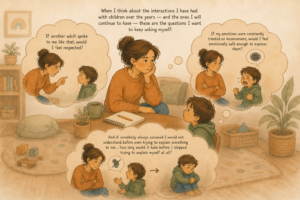
When I think about the interactions I have had with children over the years — and the ones I will continue to have — these are the questions I want to keep asking myself:
If another adult spoke to me like that, would I feel respected?
If my emotions were constantly treated as inconvenient, would I feel emotionally safe enough to express them?
And if somebody always assumed I would not understand before even trying to explain something to me… how long would it take before I stopped trying to explain myself at all?
I do not think any of us will get this right all the time.
There will still be busy days, rushed responses, and moments we wish we could handle differently after the fact. But maybe the important part is the willingness to reflect on them.
I am grateful to work in a place where conversations like these can happen openly. The kind of place where people can question, reflect, disagree, wonder out loud, and rethink things together without immediately becoming defensive or judged.
I do not think these conversations are always easy, but I do think they matter.
And if nowhere else, I hope “Behind the Crayons” can continue to be a space where we are allowed to wonder about them together.
Children may be small.
But they are not lesser.
— The Teacher Behind the Crayons
💬 I’d love to hear from you! Have you had a “pause and breathe” moment with your little learners? Or maybe a funny story about a fire drill and a glitter explosion? Share your thoughts, questions, or classroom wins in the comments below—let’s keep the conversation going.
Discover more from Behind The Crayons
Subscribe to get the latest posts sent to your email.


You May Also Like
Emotional Intelligence: Social Skills
August 17, 2025
When Did We Stop Playing?
June 2, 2026