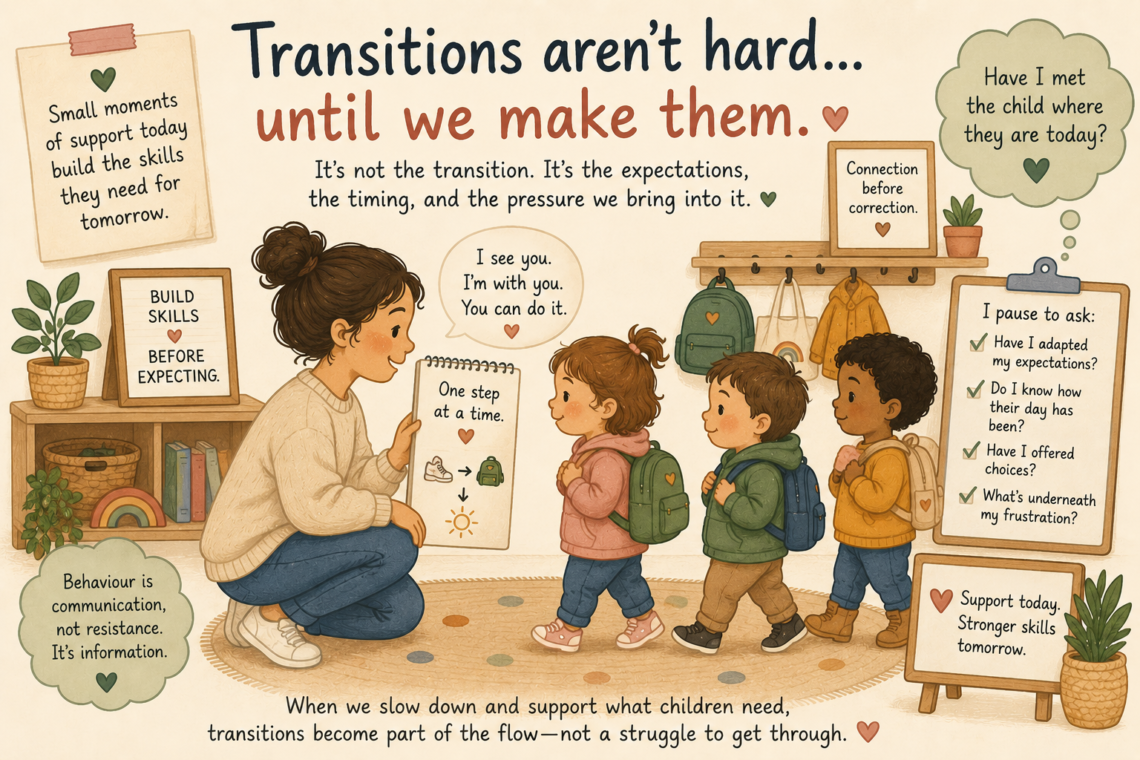
Transitions aren’t hard… until we make them.

I’ve been hearing a lot about transitions over the years that I have been in this field and for some reason the question(s) never change.
“How do we make them smoother?”
“What strategies actually work?”
“Why do toddlers struggle so much with transitions?”
Those are important questions but in between the noise, the movement, the half-finished play and the “it’s time to clean up!” moments… I keep coming back to something a little uncomfortable:
What if it’s not the transition that’s hard… but the way we expect it to happen?
I’ve been noticing that transitions don’t usually fall apart at the beginning. They fall apart the moment I start rushing them. You know the moment.
I’m watching the clock, thinking about what’s coming next, trying to move a whole group along just a little bit faster. And that’s when it shifts.
Because for the children—especially the toddlers I’ve worked with—this isn’t just “moving from A to B.”
It’s:
- leaving something meaningful
- letting go of control
- shifting their body and attention
- processing what comes next
And I’m asking them to do all of that… fast. No wonder it feels hard.
When I slowed transitions down, something interesting happened.
I started noticing:
- who isn’t ready yet
- who needs a warning
- who needs connection before movement
- who is already trying—but needs more time
Instead of adding expectations, I find myself building toward them. Not all at once and perfectly. Just one small step at a time.
I’m learning that transitions don’t have to be “successful” from the start. They just need to be supported.
Lately, I’ve been asking myself a different question.
Not “How do I get them to transition?”
But:
“What do they need before they can?”
That might look like:
- practicing waiting (in playful, low-pressure ways)
- building impulse control through games
- understanding routines through repetition
- feeling emotionally ready to let go of what they’re doing
Especially with toddlers, I’ve realised these aren’t skills I can expect— they’re skills I need to teach, model, and come back to again and again.
The question to really ask ourselves about transitions is: “Are routines for us… or them?”. This is where I’ve had to pause a little longer. When I really look at our day… not every transition exists for the children.
Some exist because:
- it fits the schedule
- it keeps the room organized
- it feels efficient for me
Sometimes… I just haven’t questioned it. So I’ve started asking myself:
- Do we actually need this transition?
- What happens if I remove or adjust it?
- What are the children showing me about how it’s working?
And maybe more importantly:
- Have I met the child where they are right now?
- Have I adapted my expectations—or am I holding onto how it “should” look?
- Do I know how their day has been so far?
- Have I offered choices, or only directions?
- What might be sitting underneath my frustration in this moment?
Sometimes, in the middle of all that, I catch myself wondering…
if I spoke to a colleague the way I’m about to speak to this child—would it feel okay?
Because transitions don’t just show us what children can do.
They show us how we respond when things don’t go as planned.
The more I think about it, the more I see that behaviour during transitions is feedback. Not resistance or defiance. Just information.
Information about:
- readiness
- capacity
- connection
- and the gap between what I’m asking… and what’s actually possible
And if behaviour is communication… what is this transition trying to tell me?
I’ve noticed that when transitions become another “task,” children feel it. And honestly… I feel it too. But when they become part of the flow, something softens.
Some of the moments that work best don’t even feel like transitions:
- Starting and finishing meal times by table- instead of all at once.
- turning handwashing into a rhythm instead of a rush
- calling children over through play instead of instruction
Sometimes, it looks like this:
- “Hot potato” to transition (whoever has the ball goes to wash hands)
- Freeze statues—the wonkiest statue gets to go next
- Movement games before lining up
- At story time, children are excused per group after each book or a chapter.
Not because I’m trying to manage behaviour… but because I’m supporting regulation, connection, and readiness.
Working with toddlers has really shifted this for me. I’ve had to remind myself that transitions aren’t something to manage in the moment— they’re something to build over time.
That might look like:
- practicing “stop and go” as a game
- taking turns on purpose—not just expecting it
- slowing routines down enough that they can actually experience them
It’s not about getting through the transition. It’s about helping children develop the skills to eventually move through them on their own.
What this can look like in real life
I found myself in one of those conversations recently with a colleague who had just stepped into a Lead Teacher role in a toddler room.
One of the biggest challenges she brought up—especially in the winter—was getting outside. And I could picture it straight away. Children not sitting where they were supposed to while getting ready. Running off mid-transition. Dropping to the ground halfway through the walk.
The kind of moments that make you think, “this just isn’t working.”
At first, it sounded like a transition problem but as we talked, something shifted. Instead of focusing on how to get them outside the way it’s “supposed” to happen, she started asking:
“What skills are missing here?”
Because it wasn’t just about going outside.
It was:
- impulse control
- the ability to wait
- staying with the group
- sustaining attention through a multi-step routine
- independence
And for toddlers… those are big asks. So she did something that can feel a bit uncomfortable at first.
She stepped back.
Not away from the children—but away from the expectation that the transition needed to be “fixed” right now.
Instead, she started building the skills before the transition:
- playing games that practiced stopping and starting
- activities that supported focus
- small moments of waiting that felt manageable
- opportunities to practice patience without the pressure of “we need to go now”
And importantly she took time to get to know the children’s individual needs.
And yes—it took time. It felt slower in the beginning and maybe even a bit inconvenient. But more intentional.
After a few weeks… The difference was noticeable. Not because the children had learned to comply— but because they had been given the chance to develop the skills the transition was asking of them.
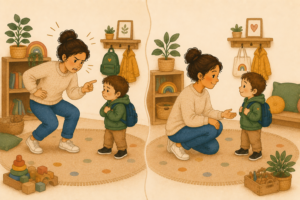
I’m starting to realise that sometimes I try to fix the transition… when what actually needs my attention is my frustration with it. And that can be hard to acknowledge as often that is not what is talked about.
If I’m honest, my frustration usually feels justified in the moment:
- the schedule is tight
- other children are waiting
- it’s loud, messy, unpredictable
- and sometimes… it’s the same struggle all over again
But I have to ask myself:
Why am I getting frustrated right now?
Is it because:
- things aren’t going to plan?
- I feel out of control?
- I’m being pulled in too many directions at once?
- I’m holding onto what this “should” look like?
- is there something outside of the classroom affecting how I’m showing up?
Or is it because the children truly have what they need… and are choosing not to use it?
Those are very different situations.
Every time I redirect a child—or a whole group—I’ve started to come back to this:
Why am I doing it?
Is it because:
- they’re ready for the next step?
- or because I need them to be?
And I’m noticing that this is often where transitions either become manageable… or overwhelming.
When I act from frustration, I can hear it in my voice:
“Come on, let’s go.”
“Hurry up.”
“You know what to do.”
But when I pause—even briefly—I start to see something else:
- a child who isn’t finished yet
- a child who didn’t understand the expectation
- a child who wants to follow along but doesn’t have the skills in that moment
And suddenly, the transition isn’t the issue. It’s the gap between what I’m asking… and what’s actually possible.
That doesn’t mean I ignore the routine or that I never move things along. It means I’m slowly shifting from:
“How do I get them through this?”
to
“What’s getting in the way—and how can I support that?”
Sometimes, the most powerful change in transitions doesn’t come from a new strategy. It comes from a small, quiet shift in me.
Transitions don’t need to be perfect. They don’t need to be silent, quick, or smooth every time. They need to make sense—for the children experiencing them. Maybe that’s the shift I’m holding onto right now:
Not asking, “How do I get better at transitions?”
But instead:
“How do I make transitions make more sense for the children in front of me?”
Behind the crayons, transitions aren’t just about moving children through the day.
They’re about how I choose to move with them.
— The Teacher Behind the Crayons
💬 I’d love to hear from you! Have you had a “pause and breathe” moment with your little learners? Or maybe a funny story about a fire drill and a glitter explosion? Share your thoughts, questions, or classroom wins in the comments below—let’s keep the conversation going.
Discover more from Behind The Crayons
Subscribe to get the latest posts sent to your email.


You May Also Like

Peace of Mind Curriculum
February 1, 2026
The Strength I Didn’t Understand Yet
March 22, 2026